
- Last updated: June 30, 2025
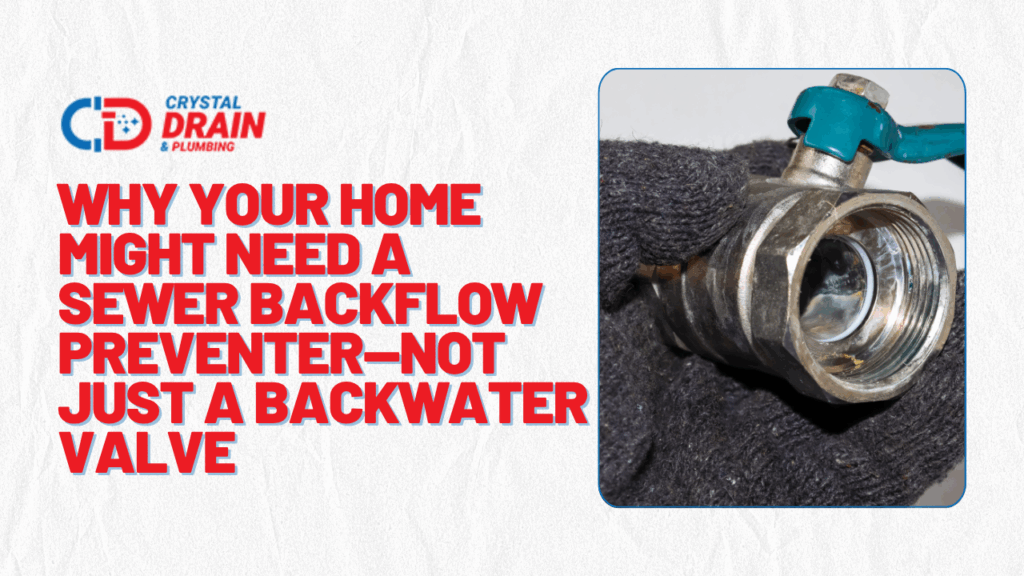
Why Your Home Might Need a Sewer Backflow Preventer—Not Just a Backwater Valve
Think Twice Before You Reach for That Bottle
If you’ve installed a backwater valve in your home, you’re already taking an important step toward preventing basement flooding and sewer backups.
But here’s what many homeowners in flood-prone areas don’t realize:
A backwater valve isn’t the same as a sewer backflow preventer—and in some cases, you may need both.
At Crystal Drain & Plumbing, we often get asked about the difference between these two critical devices. In this post, we’ll explain how they work, how they differ, and when a sewer backflow preventer might be the added protection your home needs.
What Is a Backwater Valve?
A backwater valve is a one-way valve installed on your home’s main sewer line. Its job is to prevent sewage from backing up into your home during heavy rainfall or sewer system overloads.
How it works:
- When everything flows normally, the valve stays open.
- If water starts to flow in the wrong direction (back toward your home), the valve flap closes automatically.
- This stops dirty wastewater from entering your basement.
Backwater valves are often required by code in Toronto and other GTA municipalities for flood-prone homes.
What a Backwater Valve Doesn’t Protect Against
While a backwater valve helps protect your home from municipal sewer backups, it only protects against backflow in one direction—and usually from the main sewer line.
If you have multiple drainage lines, commercial plumbing, or basement fixtures that are lower than the sewer line, you could still be vulnerable to:
- Greywater or sewage re-entering through branch lines
- Cross-connections between sewer and storm systems
- Contaminated water entering through non-protected drains
That’s where a sewer backflow preventer comes in.
What Is a Sewer Backflow Preventer?
A sewer backflow preventer is a more comprehensive device that blocks contaminated or unwanted water from re-entering your clean water or drainage systems—especially during pressure changes or flooding events.
It may include:
- Multiple check valves
- Air gaps
- Pressure-sensing shut-off mechanisms
- Floor drain protection
These devices are commonly used in commercial buildings, apartment complexes, or homes with complex or high-risk plumbing configurations.
Think of it as advanced plumbing armor for multi-drain systems or high-risk flood zones.
Backwater Valve vs. Sewer Backflow Preventer: What’s the Difference?
| Feature | Backwater Valve | Sewer Backflow Preventer |
| Primary Purpose | Prevent sewer backup from city lines | Prevent reverse flow in any part of plumbing |
| Installed On | Main sewer line | Branch lines, floor drains, water lines |
| Ideal For | Standard homes with basement bathrooms or floor drains | Homes in high-risk flood zones or with complex plumbing |
| Cost | Lower | Slightly higher, but more comprehensive |
| Code Requirement | Often required by city (e.g., Toronto) | Optional but recommended for added protection |
Who Should Consider a Sewer Backflow Preventer?
You may benefit from adding a sewer backflow preventer if:
- You’ve experienced multiple floods or sewer backups
- You live in a low-lying neighborhood or near a storm drain
- Your home has basement fixtures or multiple drain lines
- You own a duplex, triplex, or commercial property
- You want added protection beyond what a standard valve offers
Professional Assessment = Peace of Mind
At Crystal Drain & Plumbing, we offer:
- On-site inspections to assess your home’s plumbing vulnerability
- Backwater valve installations (including Toronto subsidy assistance)
- Sewer backflow preventer installation for complete system protection
- 24/7 emergency plumbing support for any drainage-related issues
Protect Your Home from Every Angle
In today’s climate, flood prevention is no longer optional—it’s essential. Whether you need a code-compliant backwater valve or advanced protection with a sewer backflow preventer, we’ll help you make the right choice for your home.
FAQs
You should run your dehumidifier continuously in the humid months, or at least when humidity levels are above 50%.
Signs include a musty smell, visible mold, condensation on walls, or dampness.
The size depends on the square footage and moisture levels. Condenser dehumidifiers are suitable for 500-2,500 square feet, while venting dehumidifiers can cover up to 7,000 square feet.
While they have an upfront cost, dehumidifiers are energy efficient, especially venting models, and can save money by preventing costly repairs due to moisture damage.
Dehumidifiers prevent mold growth but won’t remove existing mold. You may need professional cleaning for severe mold issues.